An Honest Take on Websites and SEO for Roofers
What you actually need, what can wait, and how to avoid getting burned by agencies.
Most roofers have either been burned by a marketing agency or know someone who has. The stories are always the same: paid $1,500 a month for six months, got a handful of “impressions” on a report they couldn’t make sense of, and never saw a single lead they could trace back to the investment.
The problem isn’t that websites and SEO don’t work. They do. The problem is that most agencies sell the same package to a brand-new company that they sell to a 10-year operation doing $2M in revenue. What you need depends entirely on where your business is right now. Here’s a straight breakdown.
GBP and a Website Are Non-Negotiable. From Day One.
Before you complete your first job, two things need to exist: a Google Business Profile and a professional website. These aren’t optional. They’re the bare minimum for being a legitimate business online in 2026.
Google Business Profile is free. It takes an afternoon to set up and verify. Once it’s live, every completed job is an opportunity to collect a review. Those reviews start compounding immediately — they build trust with future customers and directly influence where you show up in local search results. If you wait three years to set one up, you’re three years behind every competitor who didn’t. We covered how GBP and SEO work together in our post on how SEO and Google Business reviews dominate local search.
A professional website does not cost $5,000. If someone is quoting you five grand for a basic roofing website with a few service pages and a contact form, they’re overcharging you. A clean, fast, professional site can be built for a fraction of that if you find someone who scopes to what you actually need instead of upselling you a $5k “premium package” with features you won’t use for two years.
Your website’s job at this stage is simple: exist, look professional, load fast on a phone, list your services, and give people a way to contact you. That’s it. When a homeowner gets your name from a neighbor and Googles you, what they find in the next five seconds decides whether they call you or the next guy. No website — or a weak template site — and there’s a good chance that referral goes with someone else.
And here’s the part nobody tells you: a bad website is worse than no website at all. No site, and someone might give you the benefit of the doubt — maybe you’re just a small operation that hasn’t gotten around to it. A site that looks like it was thrown together in 2017 with broken links, stock photos, and text that runs off the screen on mobile? That actively makes you look unprofessional. It tells people you either don’t care or you don’t know the difference. Either way, they’re calling someone else.
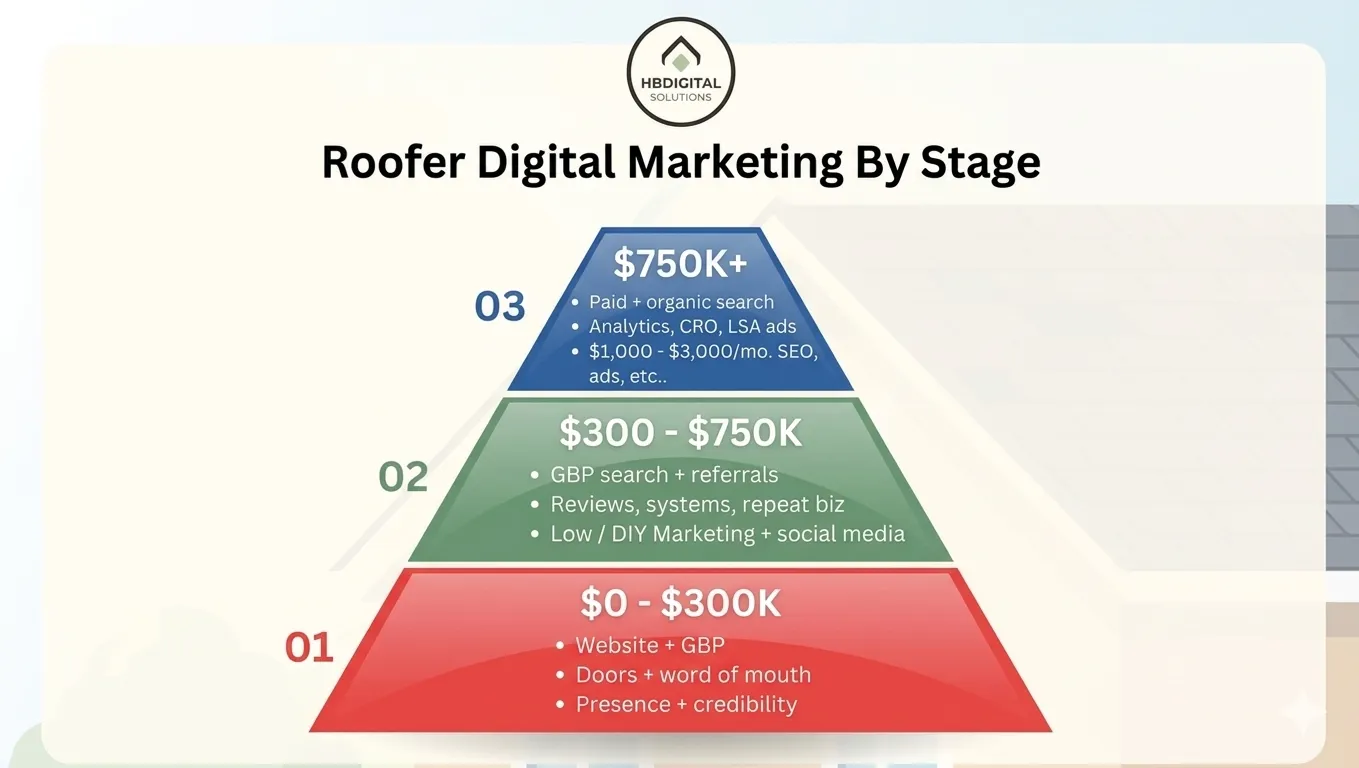
What You Actually Need When You’re Starting Out ($0–$300K)
In your first year, you have a thousand fires to put out. Insurance, licensing, CRM, distributor accounts, crew management, bookkeeping, payroll, contracts — and that’s before you sell or manage a single job. The last thing you need is a marketing agency asking for $1,500 a month.
Here’s what actually matters at this stage:
- Google Business Profile — set up, verified, and collecting reviews after every job.
- A professional website — your services, your service area, real photos when you have them, and a contact form. Nothing more.
- Door knocking and referrals — your primary lead sources. The ROI on door knocking is almost impossible to beat early on. A couple hundred dollars in shirts, hats, and business cards, and you’re generating revenue.
- Word of mouth — do great work, ask for reviews, and let your reputation build naturally.
Your website’s job right now is to not embarrass you when someone Googles your company name. That’s the bar. It doesn’t need to be a lead generation machine yet. It needs to look like you’re a real business that does real work.
What Can Wait Until You’re Established ($300K–$750K)
Once you have cash flow, your processes figured out, and a foundation of reviews, it’s time to invest in the things that expand your reach:
- SEO optimization — on-page SEO, schema markup, page speed improvements, and content that targets the searches real buyers are making in your area.
- Local service pages — dedicated pages for every city and service you offer. “Roof repair McKinney TX” is a search with buying intent. A page targeting it can rank within weeks. We wrote an entire breakdown of why local service pages outperform blog posts for contractors.
- Review funnels and automation — automated review requests after completed jobs, follow-up sequences, and systems that capture leads while you’re on the roof.
- Content strategy — not random blog posts, but targeted content that builds topical authority and captures long-tail searches in your market.
These are force multipliers, not foundations. They compound over time and work best once you have enough reviews, enough completed jobs, and enough operational stability to actually handle the leads they generate. Don’t let anyone sell you these before you’re ready.
Why Most Roofers Have Been Burned
Let’s be direct: the digital marketing industry has a well-earned bad reputation in the trades. Roofers especially have been targets because the average job value is high and most owners don’t have the time or background to evaluate marketing claims.
Here’s what the bad agencies do:
- Charge $5,000+ for a template site — they buy a $60 WordPress theme, swap in your logo and colors, and bill you five grand for the “custom” build. You could have gotten something better for a fifth of the price from an agency that right-sizes to your needs.
- Lock you into $1,000+/month retainers — with vague deliverables like “SEO optimization” and “content marketing.” When you ask what they actually did last month, you get a PDF full of impressions and “keyword movement” charts that mean nothing to you.
- Show vanity metrics instead of leads — impressions, clicks, “ranking improvements.” None of that matters if your phone isn’t ringing. A good agency reports in leads and calls, not charts designed to justify their invoice.
- Don’t give you access to your own accounts — they own your Google Analytics, your GBP login, your hosting. If you leave, you start from scratch. That’s by design.
- Sell year-one companies year-three services — a roofer doing $200K in revenue does not need a $1,500/month SEO retainer, local service ads management, and a content calendar. They need a website and a GBP. Period.
Not every agency is like this. But enough of them are that if you’re a roofer reading this, you probably just nodded at half that list.
What a Good Agency Looks Like
The opposite of everything above:
- They scope to your stage of business. If you’re in year one doing $150K, they sell you a website and GBP setup — not a full marketing stack. If you’re doing $750K and want to grow, they layer on SEO, service pages, and automation.
- They don’t oversell. If you don’t need it yet, they tell you. An agency that talks you out of spending money you don’t need to spend is one you can trust when they tell you it’s time to invest.
- They charge fairly for a starter site. A professional roofing website with a few service pages, a contact form, and clean mobile design should not cost thousands. It should cost what the work is actually worth for the scope involved.
- They give you direct access to the person doing the work. Not a support ticket. Not a project manager who relays messages. The actual person building your site and running your marketing.
- They let you add on services as you grow. Review funnels, SEO, local service pages, automation — these become add-ons when your business is ready for them, not line items on a bloated first invoice.
- They report in plain English. Leads. Calls. Form fills. Where they came from. What changed. If someone can’t explain their work without jargon, they’re hiding behind it.
A Realistic Timeline for ROI
If someone promises instant results from SEO, they’re lying to you. Here’s what an honest timeline actually looks like:
- Website (immediate) — starts working for you the day it goes live. Every referral who Googles you now finds a professional site instead of nothing. That alone saves you leads you were already losing.
- Google Business Profile (1–3 months) — once you have 10–20 genuine reviews, you start showing up in the local map pack for searches in your area. More reviews = more visibility = more calls.
- SEO (3–6 months) — once you start investing, well-built local service pages can begin ranking within weeks for lower-competition terms. Broader terms take three to six months. This is a compounding investment — the longer it runs, the more it returns.
- Full organic lead generation (12–18 months) — this is where Google brings you consistent inbound leads without ad spend. It takes time to build. But once it’s running, it’s the most cost-effective lead source a roofing company can have.
None of this is instant. But all of it is real. The agencies that promise you’ll be “on page one in 30 days” are the same ones you’ll be warning other roofers about six months from now.
Frequently Asked Questions
How much should a roofing website cost?
It depends on scope, but a clean, professional roofing website with service pages, a contact form, mobile-first design, and basic SEO structure should not cost $5,000. Agencies that charge that for a starter site are overcharging. Find someone who scopes the build to what you actually need right now. Reach out for a free quote and we’ll show you what a right-sized build looks like.
Is SEO worth it for a new roofing company?
Not immediately. If you’re in your first year, your budget and energy are better spent on door knocking, referrals, and collecting Google reviews. SEO is a compounding investment that works best once you have cash flow and operational stability — usually around year two or three. When you’re ready, it’s one of the highest-ROI marketing channels available.
How do I know if my marketing agency is scamming me?
Red flags: they locked you into a long contract, you don’t have login access to your own Google Analytics or GBP, their monthly reports are full of impressions and “keyword rankings” but you can’t point to a single lead that came from their work, they can’t explain what they did last month in plain English, and they sold you a full marketing stack in your first year of business.
When should I start investing in SEO?
When you have consistent cash flow, your core operations are stable, and you have a foundation of Google reviews (at least 15–20). For most roofing companies, that’s somewhere around $300K–$750K in annual revenue. At that point, SEO and local service pages become force multipliers that expand your reach into every city you serve.
What’s the difference between a website and SEO?
A website is the foundation — it’s where people land when they find you. SEO is the strategy that gets people to find you in the first place. You need the website from day one. SEO is what you layer on top once the foundation is solid and your business can support the investment.